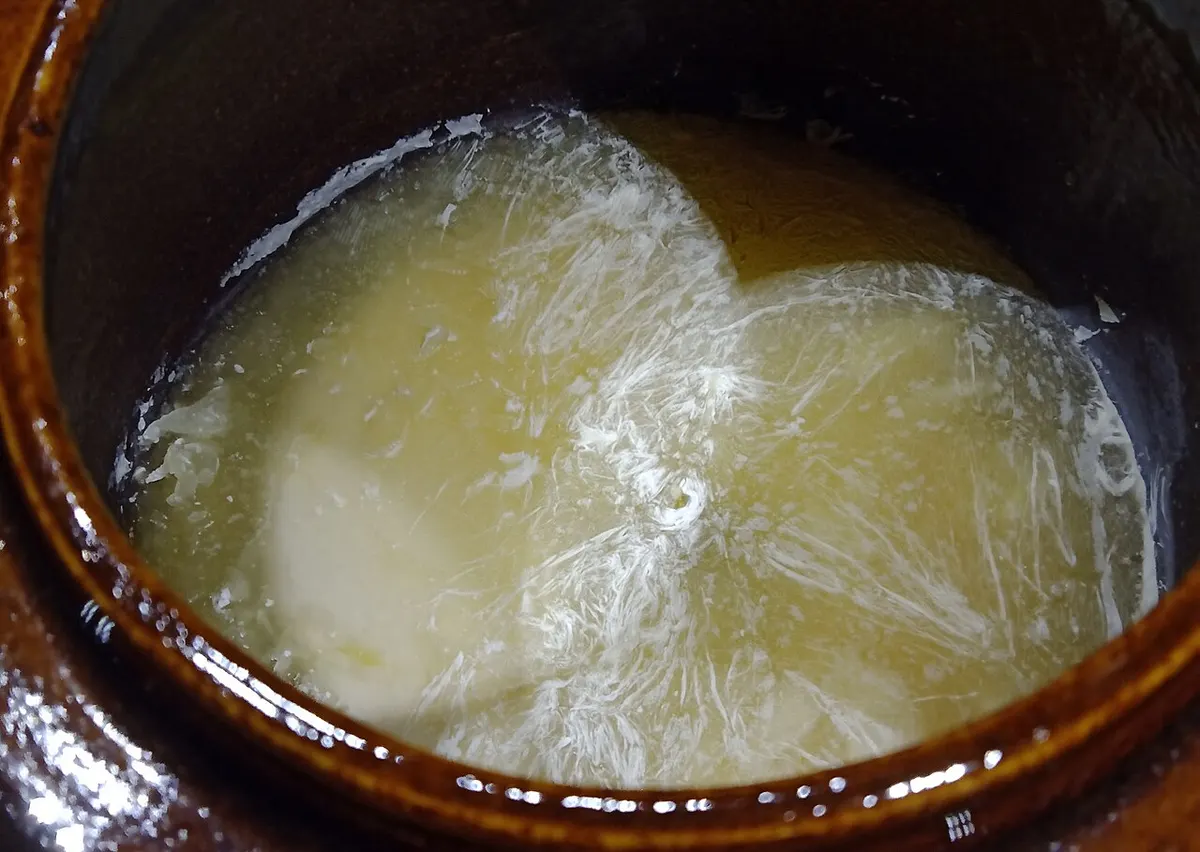
Sooner or later you will lift the lid on a ferment and find a pale film on top. The kahm yeast vs mold question is the most common panic in fermenting, and the answer decides whether you skim and carry on or throw the whole thing away.
Here is how to tell them apart, what extension services say to do about each, and how to set up your jars so you see less of both.
What is kahm yeast?
Kahm yeast is not one organism. It is a catch-all name for a thin layer of wild yeasts that can form on the surface of fermented foods like sauerkraut and pickles. The yeast genera usually involved include Debaryomyces, Mycoderma, and Pichia.
These yeasts grow where brine meets air. They are generally considered harmless, but they can spoil flavor and aroma if left to spread, so fermenters skim them off.
Extension sources describe the same thing without the German name. Oregon State University Extension calls it “white scum” on top of sauerkraut, caused by a weight and liquid layer that is not sufficient to exclude air. Its fix: skim off the surface layer.
What does mold look like on a ferment?
Mold is a different organism entirely: a fungus that grows in fuzzy, raised colonies. On a ferment it usually shows up as round spots that are white, blue, green, black, or pink, and it tends to form on anything poking above the brine, like a stray shred of cabbage or the edge of a weight.
The important difference is what mold does below the surface. The USDA Food Safety and Inspection Service explains that molds send root threads into food, and that these roots can be difficult to see and may run deep. Some molds produce mycotoxins, poisonous substances that can be concentrated in and around those threads and in some cases spread through the food.
Kahm yeast vs mold: side by side
| Kahm yeast | Mold | |
|---|---|---|
| Appearance | Flat, thin, film-like layer | Raised, fuzzy or hairy spots |
| Color | White to off-white or cream | White, green, blue, black, pink, or orange |
| Shape | Continuous skin, may wrinkle or look powdery | Distinct circular colonies |
| Texture when touched | Smooth or slightly wrinkled; breaks up into flakes | Fluffy, dry-looking, cottony |
| Where it grows | Across the brine surface | Often on bits above the brine, weights, or jar walls |
| Smell | Yeasty, musty, sometimes like old bread or beer | Musty, earthy, or rotten |
| What to do | Skim off; check the ferment underneath | Small patch: remove with care; extensive or deep: discard |
If the growth is flat and white and smells yeasty, it is almost certainly kahm. If it is fuzzy, raised, or colored, treat it as mold.
What to do about kahm yeast
- Skim it. Use a clean spoon to lift off as much of the film as you can. It tends to break into flakes, so some bits left behind is normal.
- Wipe the jar walls above the brine with a clean paper towel.
- Check what is underneath. The cabbage or vegetables below should smell sour and look normal.
- Fix the cause. Press everything back under the brine and make sure the weight actually holds it down. Top up brine if needed.
Kahm tends to come back if the conditions stay the same, so step 4 matters more than step 1.
What to do about mold
Extension guidance here is more cautious, and it depends on how much mold you see.
Oregon State University Extension’s sauerkraut troubleshooting says small patches of mold on kraut can be skimmed off, but if mold is extensive, discard the entire batch. It links moldy kraut to fermentation above 75°F and inadequate coverage.
Penn State Extension, on the other hand, says to check pickles several times a week and promptly remove surface scum or mold, and not to proceed with sauerkraut if you see mold on the surface, feel a slimy texture, or smell a bad odor.
Our reading of those sources, and the approach we suggest:
- One small spot on a piece sticking above the brine, with firm, sour-smelling vegetables below: remove the affected piece plus a generous margin around it, clean the weight and jar walls, and watch closely.
- Mold across the surface, colored mold, or mold that has reached into the vegetables: discard the whole batch.
- Any slimy texture or rotten smell, with or without visible mold: discard.
Why so strict? FSIS advises discarding soft, high-moisture fruits and vegetables with mold because they can be contaminated below the surface. Fermented vegetables in brine are about as soft and moist as food gets.
When should you throw out the whole ferment?
Throw it out if you see any of these:
- Fuzzy mold across much of the surface, or mold growing down into the vegetables
- Mold in colors like black, green, blue, or pink spreading across the batch
- Slimy or mushy vegetables. Oregon State lists slimy kraut as spoilage, caused by temperatures above 75°F or too little salt.
- A rotten, putrid, or genuinely foul smell, as opposed to sour and funky
- Rotten, discolored vegetables where the ferment was not covered
Some color changes are fine. Oregon State says pink kraut, usually from yeast growth due to uneven salting or poor coverage, is safe unless it is also slimy.
How to prevent kahm yeast and mold
Both love the same thing: air on the surface. Nearly every prevention tip is about keeping vegetables under the brine and limiting oxygen.
| Cause | Fix |
|---|---|
| Vegetables floating above the brine | Use a weight that covers the full surface: a glass weight, a brine-filled bag, or a folded cabbage leaf plus a weight |
| Not enough brine | Top up with 1 1/2 tablespoons of salt per quart of water (the NCHFP ratio) |
| Too little salt | Weigh salt at 2 to 2.5 percent of vegetable weight |
| Warm room | Ferment at 70 to 75°F; above 75°F raises the odds of mold and soft kraut |
| Too much headspace in a crock | Pack crocks 75 to 80 percent full so there is less air above the ferment |
| Open containers | Use an airlock lid, a water-seal crock, or cover with cloth to keep out dust and flies |
| Dirty tools | Wash jars, weights, and hands before packing |
Airlock lids and water-seal crocks help because they let fermentation gas out without letting fresh air in. Penn State Extension lists commercially available weights and one-way valve covers as an alternative to cloth-covered jars.
If you ferment in open crocks, check more often. Penn State notes that with jar weights you should check two to three times a week and remove scum as it forms.
The short version
- Kahm yeast is a flat, white, film-like layer of wild yeast; it is generally harmless but can spoil flavor.
- Mold is raised and fuzzy, often colored, and grows root threads below the surface.
- Skim kahm yeast, then fix the cause, which is usually vegetables above the brine.
- Oregon State Extension says small mold patches on kraut can be skimmed but extensive mold means discarding the whole batch.
- Discard any ferment that is slimy or smells rotten.
- Ferment at 70 to 75°F with 2 to 2.5 percent salt, and keep every piece under the brine.
Related guides
For the basics of a first batch, start with how to make sauerkraut in a mason jar. If you keep fighting surface growth in jars, a water-seal crock may help; see the best fermentation crocks for sauerkraut and pickles. Newcomers can get the lay of the land in our beginner’s roadmap to preserving food at home. Sources: Oregon State University Extension on sauerkraut problems and USDA FSIS on molds on food.