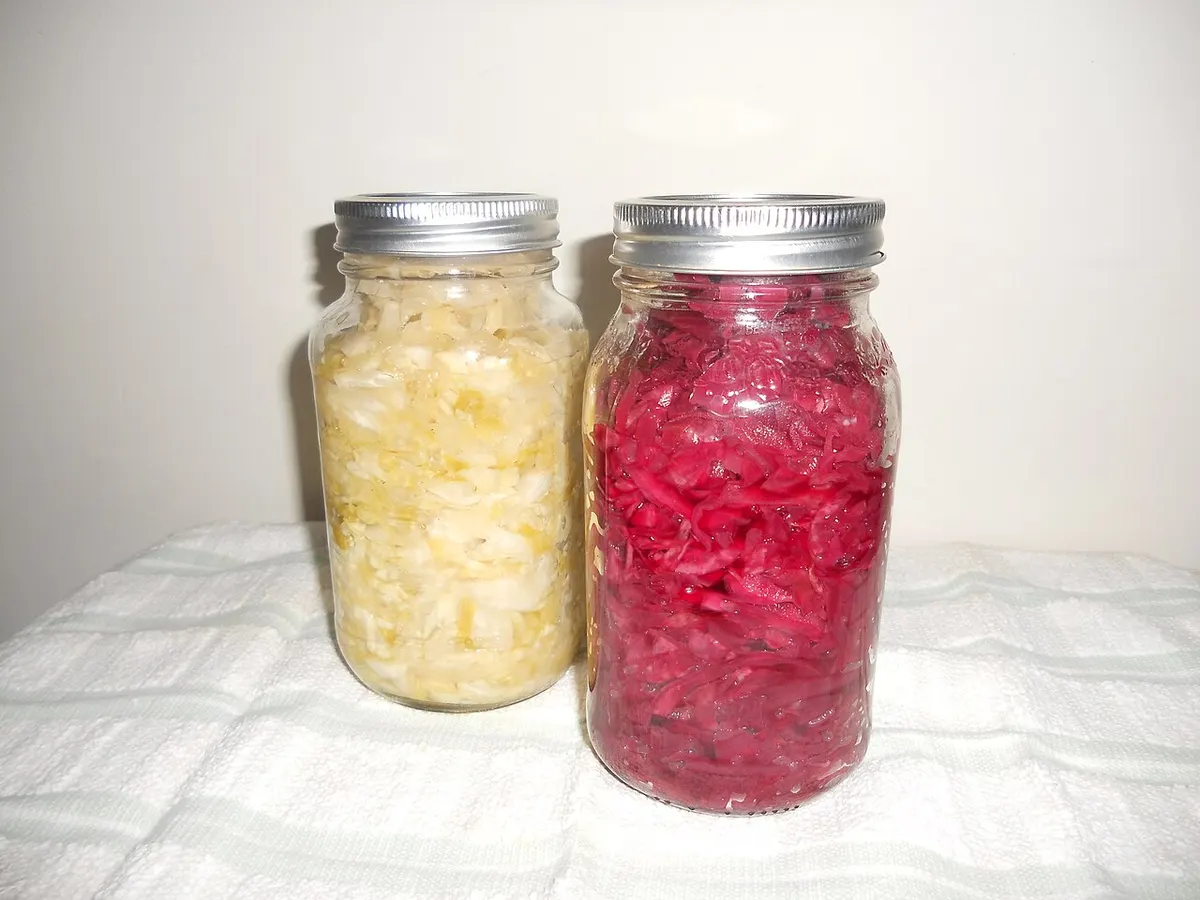
Learning how to make sauerkraut in a mason jar takes one head of cabbage, some salt, a jar, and about ten minutes of actual work. The rest is waiting. Nothing else on this site gives you more flavor for less effort.
The catch is that “a pinch of salt” recipes are where most first batches go soft, slimy, or moldy. So this guide works by weight, uses numbers from university extension sources, and tells you exactly how much cabbage fits in each jar size.
What you need to make sauerkraut in a jar
- Green cabbage. One medium head is usually 2 to 3 pounds.
- Canning and pickling salt, or another pure salt without iodine or anti-caking agents. Extension sources call for canning or pickling salt because additives can darken kraut or cloud the brine.
- A wide-mouth mason jar. A quart jar is the easiest starting size.
- A kitchen scale that reads in grams. This is the single most useful tool in fermenting.
- A weight to keep the cabbage under the brine: a glass fermentation weight, a small jelly jar filled with water, or a sealed food-grade bag of brine.
- A lid that lets gas out: an airlock lid, or a regular lid left loose, or a cloth held with a band.
How much salt for sauerkraut?
Salt is the one ingredient you have to get right. Too little and the wrong microbes get a head start; Oregon State University Extension links salt under about 1.7 percent with soft kraut. Too much and fermentation stalls.
The classic extension ratio is 3 tablespoons of canning salt per 5 pounds of cabbage. Canning salt weighs about 6 grams per teaspoon (Morton lists 1/4 teaspoon at 1.5 grams), so that ratio lands at roughly 2.4 percent by weight. Most small-batch fermenters work at 2 to 2.5 percent. That is the range we recommend: 2 percent in a cool kitchen, closer to 2.5 percent if your kitchen runs warm.
The math is easy once you weigh. Multiply the weight of your trimmed, shredded cabbage by 0.02 (for 2 percent) or 0.025 (for 2.5 percent).
| Jar size | Shredded cabbage (approx.) | Salt at 2% | Salt at 2.5% |
|---|---|---|---|
| Pint (16 oz) | 1 lb (454 g) | 9 g (about 1 1/2 tsp) | 11 g (about 2 tsp) |
| Quart (32 oz) | 2 lb (907 g) | 18 g (about 1 tbsp) | 23 g (about 3 3/4 tsp) |
| Half gallon (64 oz) | 4 lb (1,814 g) | 36 g (about 2 tbsp) | 45 g (about 2 1/2 tbsp) |
The jar capacities come from University of Tennessee Extension, which notes that 2 pounds of cabbage makes 1 quart of kraut. The spoon conversions assume fine canning salt; kosher salt brands differ a lot by volume, which is exactly why the gram column is the one to trust.
Step by step: sauerkraut in a mason jar
1. Prep the cabbage
Remove the outer leaves and set one clean leaf aside. Quarter the head, cut out the core, and slice thin, about the thickness of a quarter. Thin shreds release brine faster.
2. Weigh and salt
Put a large bowl on the scale, tare it, and add the shredded cabbage. Note the weight, calculate the salt, and sprinkle it over evenly. Uneven salting is one of the listed causes of dark, pink, and soft kraut in Oregon State’s troubleshooting guide, so toss well.
3. Massage until it weeps
Squeeze and scrunch the cabbage with clean hands for 5 to 10 minutes. It will shrink by about half and sit in a puddle of its own brine. If it is stubborn, let it rest 15 minutes and go again.
4. Pack the jar tightly
Pack the cabbage into the jar a handful at a time, pressing down hard with your fist or a tamper after each addition. You are pushing out air pockets and forcing brine up over the top. Pour in any brine left in the bowl. Leave 1 to 2 inches of space below the rim, because ferments bubble up.
5. Weigh it down
Fold the reserved leaf over the surface, then set your weight on top. The goal is simple: every shred below the brine. If brine does not cover the cabbage after a few hours, top up with extension-strength brine, which NCHFP gives as 1 1/2 tablespoons of salt per quart of water.
6. Cover and ferment
Fit an airlock lid, or set a lid on loosely, and put the jar on a plate to catch overflow. Keep it out of direct sun.
How long does sauerkraut take to ferment?
Temperature decides the timeline. These numbers are from the National Center for Home Food Preservation:
| Room temperature | What to expect |
|---|---|
| Below 60°F | May not ferment |
| 60 to 65°F | 5 to 6 weeks |
| 70 to 75°F | About 3 to 4 weeks |
| Above 75°F | Faster, but kraut may turn soft |
Small jars at room temperature usually show bubbles within a few days. University of Tennessee Extension suggests letting jarred kraut ferment about 3 weeks, or until you no longer see bubbling. You can taste earlier with a clean fork. When it tastes as sour as you like, cap it and move it to the fridge.
If your kitchen runs cold in winter, the jar just needs more time. If it runs hot in summer, find the coolest cupboard you have or go up to 2.5 percent salt.
What should sauerkraut look and smell like while it ferments?
Normal:
- Bubbles rising, especially in the first week
- Cloudy brine
- A sour, pickle-like, slightly funky smell
- The color fading from bright green to pale yellow-green
- Brine rising and overflowing a little in the first days
Worth a closer look:
- A flat white film on the surface. Usually kahm yeast, a harmless but off-tasting surface yeast. Skim it off. Our kahm yeast vs mold guide shows how to tell it apart from mold.
- Pink kraut. Oregon State says this is usually yeast growth from uneven salt or poor coverage, and it is safe unless the kraut is also slimy.
Throw it out:
- Slimy texture, which Oregon State lists as a spoilage sign linked to temperatures above 75°F or too little salt
- A rotten smell, rather than a sour one
- Extensive, fuzzy mold, especially colored mold that spreads into the cabbage
How to store homemade sauerkraut
Once it tastes right, put a tight lid on and refrigerate. The NCHFP says fully fermented sauerkraut keeps in the fridge for several months. Cold slows fermentation almost to a stop, so the flavor stays close to where you left it.
Keep the kraut pressed under its brine in storage too, and use a clean utensil every time.
You can also can finished sauerkraut for shelf storage using the NCHFP’s tested hot pack or raw pack process, with times that depend on jar size and altitude. Heat processing does kill the live bacteria, so if probiotics are the point, keep it in the fridge.
Do you need special fermentation gear?
No. A plain mason jar, a loose lid, and a water-filled jelly jar as a weight make perfectly good kraut. Upgrades are about convenience:
- Airlock or one-way valve lids let gas escape without letting air in, so you do not need to burp the jar. Penn State Extension notes that commercial weights and one-way valve covers are a fine alternative to cloth.
- Glass weights sized to wide-mouth jars stay put better than improvised ones.
- A crock makes sense once you want to ferment 5 or more pounds at a time. See our fermentation crock guide.
The short version
- Use 2 to 2.5 percent salt by weight: 18 to 23 grams of salt per 2 pounds (907 g) of shredded cabbage.
- A quart mason jar holds about 2 pounds of cabbage.
- The extension ratio of 3 tablespoons of canning salt per 5 pounds of cabbage is about 2.4 percent.
- Salt below about 1.7 percent tends to produce soft kraut.
- Ferment at 70 to 75°F for about 3 to 4 weeks, or 5 to 6 weeks at 60 to 65°F.
- Keep every shred under the brine; top up with 1 1/2 tablespoons of salt per quart of water if needed.
- Refrigerated, fully fermented sauerkraut keeps for several months.
Keep going
If this is your first ferment, our beginner’s roadmap to preserving food at home shows where fermenting fits among the other methods. When you are ready to go bigger than a jar, read the best fermentation crocks for sauerkraut and pickles. For the source recipes, see the NCHFP sauerkraut page and Oregon State’s sauerkraut problems and solutions.