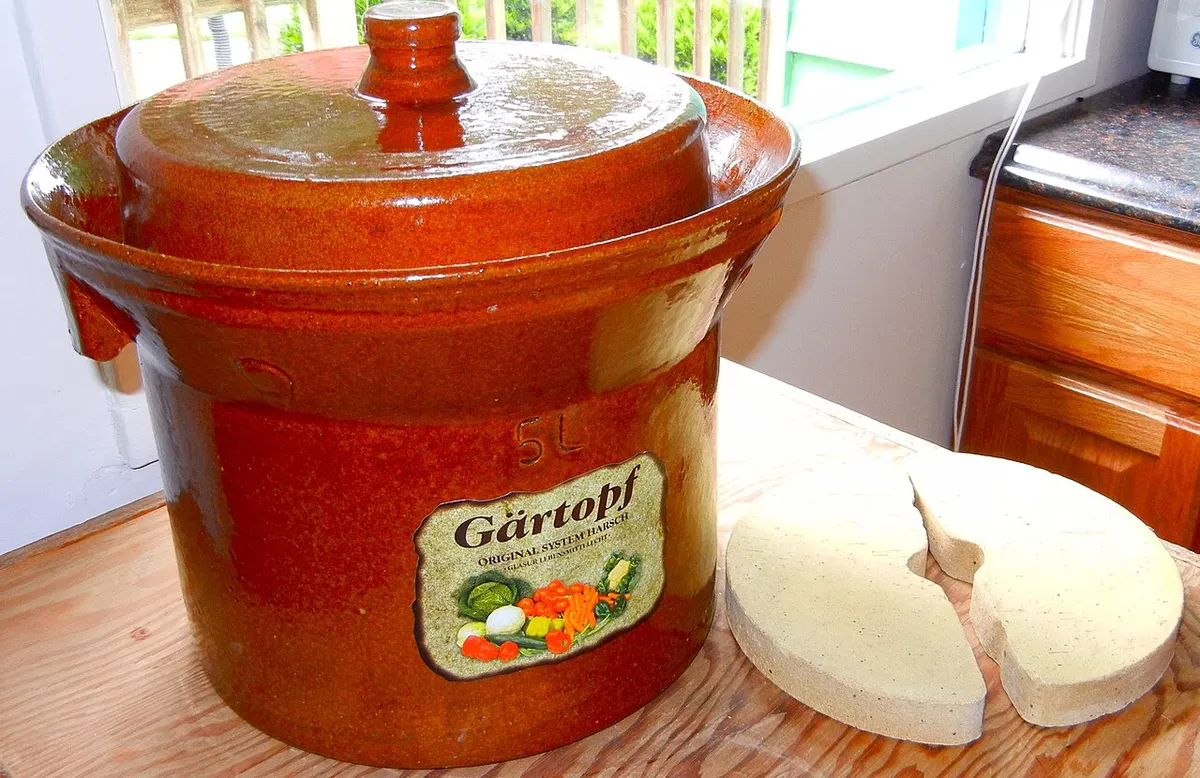
The best fermentation crock is the one sized for the batches you actually make, with a glaze you can trust and weights that keep everything under the brine. Beyond that, the big decision is style: a water-seal crock that mostly takes care of itself, or an open crock that is cheaper and easier to pack but needs more watching.
A note on how we built this guide: we have not bench-tested these crocks ourselves. The picks below are based on manufacturer specifications, extension guidance on fermentation containers, and patterns in published owner feedback. Where sources disagree, we say so.
Do you need a fermentation crock at all?
Not to start. A quart mason jar makes about a quart of sauerkraut from 2 pounds of cabbage, and our mason jar sauerkraut guide covers exactly that.
A crock starts to make sense when:
- You want to ferment 5 pounds of cabbage or more at once
- You keep fighting surface yeast or mold in jars
- You want one vessel instead of a counter full of jars
- You make seasonal batches, like a big fall kraut or summer dill pickles
Water-seal crock vs open crock: which is better?
Both work. Extension sauerkraut recipes are written around open crocks, while the water-seal crock is the traditional German design. The tradeoff is convenience versus access.
| Water-seal crock | Open crock | |
|---|---|---|
| How it works | Lid sits in a water-filled moat; gas bubbles out, air stays out | Wide open top, covered with a plate, weight, and cloth |
| Surface yeast and mold | Much less likely | More likely; needs regular skimming |
| Maintenance | Keep the moat topped up with water | Check two to three times a week |
| Packing and cleaning | Narrower mouth, harder to pack and scrub | Wide mouth, easy to pack and clean |
| Weights | Usually included, shaped to fit | Often sold separately |
| Cost | Usually higher | Usually lower |
| Best for | Set-and-forget kraut and kimchi | Large batches, pickles, people who like to check in |
MakeSauerkraut.com sums up the water-seal case well: very little chance of mold or surface yeasts, at the price of a narrower opening that is harder to pack. The main rule with a water-seal crock is to leave it closed. Every time you lift the lid, you let in the air the seal was keeping out.
What size fermentation crock do you need?
Crocks are sold in gallons or liters, but you think in heads of cabbage. Sources give slightly different conversions, so here are the published figures side by side.
| Crock size | Cabbage capacity (published figure) | Source |
|---|---|---|
| 1 gallon (about 4 L) | About 5 lb | Ohio Stoneware sizing via retailers; University of Tennessee Extension |
| 1 gallon (4 L) | Up to about 7 lb (3 kg) of vegetables | Kenley, for its 4 L water-seal crock |
| 2 gallon | About 10 lb | Ohio Stoneware sizing |
| 5 liter (about 1.3 gal) | About 10 lb, yielding 5 to 6 quarts | MakeSauerkraut.com |
| 10 liter (about 2.6 gal) | About 20 lb, yielding 10 to 12 quarts | MakeSauerkraut.com |
| 5 gallon | About 25 lb | Ohio Stoneware sizing; University of Tennessee Extension |
Two practical rules help more than any table:
- Leave room. NCHFP says the rim of a fermentation container should sit at least 4 to 5 inches above the cabbage in a large crock. MakeSauerkraut recommends packing about 75 to 80 percent full.
- Size for your fridge, not just your ambition. Ten quarts of finished kraut needs somewhere cold to live.
For most households, a 5 liter water-seal crock or a 2 gallon open crock is the sweet spot. Singles and couples may prefer a 2 liter crock or simply stick with jars.
Is the glaze on a fermentation crock safe?
This matters more than any other spec. Fermented foods are acidic, and FDA warns that lead in improperly made glazes can leach into food and drink. Penn State Extension specifically says not to ferment in lead-glazed crocks, or in copper, iron, or galvanized metal containers.
What to look for:
- An explicit lead-free claim from the maker. Ohio Stoneware describes its crocks as having a lead-free, food-safe glaze. Humble House says its SAUERKROCK uses a lead- and cadmium-free glaze.
- Caution with antique and flea-market crocks. FDA flags antique, crudely made, and brightly decorated pottery (especially orange, red, or yellow) as higher risk, and notes that no amount of washing or boiling removes lead from pottery. If you want to use an old crock, test it with a lead test kit first, and do not use it if the test is positive.
- No cracks or crazing. Damaged glaze can harbor bacteria and, on older pieces, expose problem materials.
The best fermentation crocks, by type
Best open crock: Ohio Stoneware preserving crock
Ohio Stoneware is the default American open crock, hand-turned in Ohio and sold in 1, 2, 3, 4, 5, and 10 gallon sizes with a lead-free, food-safe glaze. That range means you can match the crock to your batch almost exactly.
The tradeoff is that the crock is just the crock. Lids and stone weights are sold as separate pieces or in boxed starter kits, so check what is included before you order. As an open crock, it also needs regular checks for surface yeast.
Why it is our open-crock pick: the widest size range of any widely available open crock, a clear lead-free glaze claim, and a simple shape that is easy to pack and clean. The 2 gallon starter kit below includes the crock, a cover, and two weights, so nothing needs to be ordered separately. See other Ohio Stoneware sizes.
Pantry pick: Ohio Stoneware 2 Gallon Crock Starter Kit
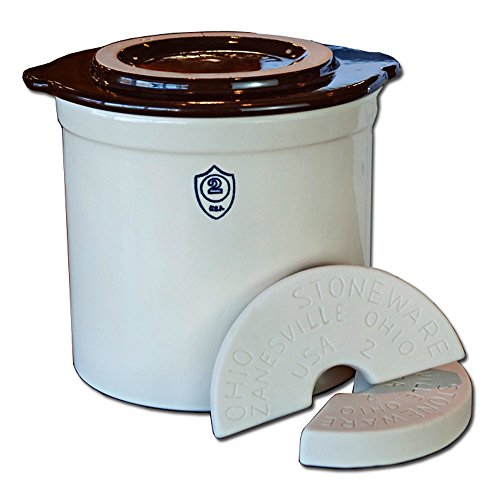
One 2 gallon crock, one cover, and two weights, per the listing. Ohio Stoneware sizing puts a 2 gallon crock at about 10 pounds of cabbage. Based on manufacturer specs and extension container guidance.
Best water-seal crock: Humble House SAUERKROCK
The SAUERKROCK is a German-style water-seal crock sold in three sizes: a 2 liter “City,” a 5 liter “Original,” and a 10 liter “Family.” Humble House includes two heavy, full-coverage glazed weights sized to each crock, and states the glaze is lead- and cadmium-free. The walls are opaque, which keeps light off the ferment.
The 5 liter size is the one to consider first. By MakeSauerkraut’s figure, that is roughly 10 pounds of cabbage per batch, enough for most households without being a monster to store.
Why it is our water-seal pick: weights included and sized to fit, three sensible sizes, and an explicit lead- and cadmium-free glaze claim. See current SAUERKROCK listings.
Best small water-seal crock: Kenley fermentation crock
Kenley’s 1 gallon (4 liter) crock uses a water-seal “burp” lid that lets gas escape while keeping air out, and comes with weighting stones, the lid, and a pounder for packing. Kenley rates it for up to about 3 kg (7 lb) of vegetables. A 5 liter version also exists.
Kenley describes its glaze as a food-safe coating but, in the product information we reviewed, does not state “lead-free” explicitly the way Ohio Stoneware and Humble House do. If that claim matters to you, and it should, confirm it with the seller before buying.
Why it made the list: a complete kit in a compact size, good for anyone who wants water-seal convenience without a 10 pound batch.
Pantry pick: Kenley Fermentation Crock, 1 Gallon

Water-seal crock with lid, weighting stones, and a pounder. The listing title says 1 gallon (4 liters) while its details mention 5 liters, so confirm the size on the listing before you order. Based on manufacturer specs.
Also worth knowing: German-made water-seal crocks
Traditional German water-seal crocks, sold in 5, 10, 15, and 20 liter sizes by specialty canning retailers, are the premium end of this category. They make sense if you ferment large batches every year and want a crock that lasts decades. For most beginners, the size range above is plenty.
Fermentation crock comparison
| Crock | Style | Sizes | Weights included | Stated glaze |
|---|---|---|---|---|
| Ohio Stoneware | Open | 1, 2, 3, 4, 5, 10 gal | Sold separately or in kits | Lead-free, food-safe |
| Humble House SAUERKROCK | Water-seal | 2, 5, 10 L | Yes, two glazed weights | Lead- and cadmium-free |
| Kenley | Water-seal (burp lid) | 4 L (1 gal), 5 L | Yes, plus pounder | Food-safe coating |
| German-made water-seal | Water-seal | 5, 10, 15, 20 L | Usually | Varies by maker |
What else do you need with a crock?
- Weights. They are non-negotiable. Anything above the brine is where mold starts. If your crock does not include them, Penn State Extension suggests a plate weighted with water-filled jars, or a food-grade bag filled with brine.
- A kitchen scale. Salt by weight: 2 to 2.5 percent of the vegetable weight.
- Canning and pickling salt, without iodine or anti-caking agents.
- A cool spot. NCHFP puts ideal kraut fermentation at 70 to 75°F. A full stoneware crock is heavy, so pick its spot before you fill it.
The short version
- Water-seal crocks keep air out with a water-filled moat and see much less surface yeast and mold; open crocks are easier to pack but need checking two to three times a week.
- A 5 liter crock holds about 10 pounds of cabbage; a 10 liter holds about 20 pounds.
- Ohio Stoneware sizes its crocks at about 5 pounds of cabbage per gallon.
- Pack a crock about 75 to 80 percent full.
- Only ferment in crocks with an explicit lead-free glaze; test antique crocks with a lead test kit first.
- For most households, a 5 liter water-seal crock or a 2 gallon open crock is the right starting size.
Related guides
Once your crock arrives, follow the salt and temperature steps in how to make sauerkraut in a mason jar; they scale up directly. If a film shows up anyway, Kahm yeast vs mold will tell you what it is. New to preserving? Start with the beginner’s roadmap. For container safety, see Penn State Extension on fermenting sauerkraut and pickles and the FDA on lead-glazed pottery.