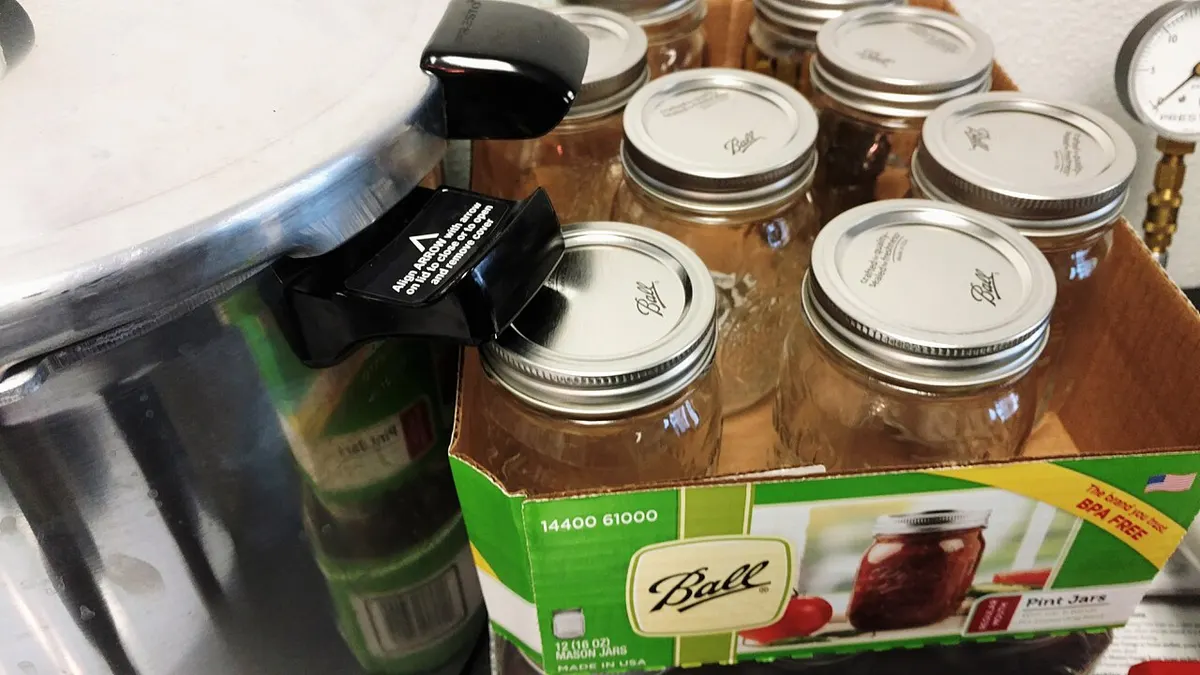
The water bath vs pressure canning question has a one-line answer: acid foods can go in a boiling water bath, low-acid foods must go in a pressure canner. Everything below explains where that line sits, why it exists, and which side your favorite foods land on.
This is not a style choice like gas versus charcoal. Picking the wrong method for low-acid food can produce jars that look, smell, and taste normal while carrying botulinum toxin. So we are going to be precise and cite our sources.
What is the difference between water bath and pressure canning?
Both methods heat filled jars long enough to destroy spoilage organisms, then let a vacuum seal form as the jars cool. The difference is how hot the jars get.
| Water bath canning | Pressure canning | |
|---|---|---|
| Max temperature | About 212°F (boiling, at sea level) | 240 to 250°F |
| How it gets there | Jars fully submerged in boiling water | Steam trapped under 10 to 15 pounds of pressure |
| Safe for | Acid foods, pH 4.6 or lower | Low-acid foods, pH above 4.6 (and acid foods too) |
| Typical gear | Deep pot with a rack | Dedicated pressure canner that holds at least 4 quart jars |
| Typical process times | 5 to 85 minutes for acid foods | 20 to 100 minutes for low-acid foods |
The temperature and time ranges come from the National Center for Home Food Preservation (NCHFP). That last row shows why you cannot “just boil it longer.” NCHFP notes that making low-acid food safe in boiling water would take 7 to 11 hours, which no tested recipe asks you to do.
Why does acidity decide the canning method?
Because of Clostridium botulinum, the bacterium behind botulism.
Its spores are everywhere in soil, so they are on fresh produce. They are also tough. NCHFP explains that botulinum spores are very hard to destroy at boiling-water temperatures, and that the higher the canner temperature, the more easily they are destroyed.
Inside a sealed jar, the spores can wake up and produce toxin when four conditions meet, per NCHFP:
- A moist food
- A low-acid food (pH above 4.6)
- A temperature between 40 and 120°F, which includes your pantry
- Less than 2 percent oxygen, which is exactly what a sealed jar provides
Acid is the condition you can control. In food with a pH of 4.6 or lower, the spores cannot grow and make toxin, so boiling-water heat is enough to handle the molds, yeasts, and less hardy bacteria that remain. In low-acid food, the only safe option is heat high enough to destroy the spores themselves, and that takes pressure.
The CDC puts it plainly: pressure canning is the only recommended method for canning low-acid foods. It also notes that home-canned vegetables are the most common cause of botulism outbreaks in the United States.
Which foods need a pressure canner?
Here is the food-by-food version, based on NCHFP and CDC classifications.
| Food | Acid or low-acid | Method | Notes |
|---|---|---|---|
| Jams, jellies, marmalades | Acid | Water bath | Follow a tested recipe for sugar and pectin |
| Most fruits (peaches, apples, berries, pears) | Acid | Water bath | Figs are an exception, see below |
| Pickles (vinegar) | Acid (acidified) | Water bath | Vinegar strength and ratio must follow the recipe |
| Sauerkraut | Acid | Water bath | NCHFP has a tested process for finished kraut |
| Tomatoes | Borderline | Water bath with added acid, or pressure | Tested recipes add lemon juice or citric acid to every jar |
| Salsa | Acidified | Water bath | Only tested recipes; ingredient ratios are a safety issue |
| Figs | Low-acid unless acidified | Water bath only with added acid | CDC lists figs with low-acid foods; tested fig recipes add lemon juice |
| Green beans, corn, carrots, potatoes | Low-acid | Pressure only | All fresh vegetables except most tomatoes are low-acid |
| Dried beans, peas | Low-acid | Pressure only | |
| Meat, poultry, seafood | Low-acid | Pressure only | |
| Stock and broth | Low-acid | Pressure only | |
| Soups, chili, stews | Low-acid | Pressure only | Use tested recipes; no thickeners, pasta, or dairy |
| Mixed foods (tomato sauce with meat or peppers) | Low-acid | Pressure only | The least acidic ingredient sets the method |
That last row trips people up. Tomatoes plus onions, peppers, or meat is no longer a tomato product; it is a low-acid mix, and it needs a tested pressure process.
Can you use a water bath canner for vegetables?
No, unless the vegetables are pickled with a tested vinegar recipe. Plain green beans, corn, carrots, and every other fresh vegetable except most tomatoes are low-acid. They need a pressure canner, full stop.
Can you use a pressure canner for acid foods?
Yes, a pressure canner can do both jobs. Many pressure canners also work as water bath canners when you leave the lid unlocked and the vent open; the Presto 23-quart models, for example, are sold as doubling for boiling water canning. Some tested recipes, especially for tomatoes, even include a pressure option as an alternative to the water bath. You still follow the recipe’s specific process for the method you choose.
What about electric pressure cookers and multicookers?
Do not use them for canning, even if they have a “canning” button. NCHFP does not support using USDA canning processes in electric multicookers, citing a lack of validated heat processing and inconsistent jar temperatures. The CDC also warns against using them for low-acid canning.
Dedicated electric pressure canners, such as the Presto Precise Digital Pressure Canner, are a separate category. NCHFP and extension staff have said they cannot independently verify the manufacturer’s testing, and advise owners to follow only that canner’s own manual. We cover this in detail in our pressure canner buying guide.
How does altitude change canning?
Water boils at lower temperatures as elevation rises. That affects both methods differently.
Water bath canning: the jars cannot get any hotter than boiling, so tested recipes add processing time at higher elevations. Every tested recipe includes its own altitude table.
Pressure canning: you raise the pressure instead. For low-acid vegetables, University of New Hampshire Extension’s tables give:
| Canner type | Altitude | Pressure |
|---|---|---|
| Weighted gauge | 0 to 1,000 ft | 10 lb |
| Weighted gauge | Above 1,000 ft | 15 lb |
| Dial gauge | 0 to 2,000 ft | 11 lb |
| Dial gauge | 2,001 to 4,000 ft | 12 lb |
| Dial gauge | Above 4,000 ft | Higher; follow the recipe’s table |
Always use the table in the specific tested recipe you are following, since times and pressures vary by food and jar size. If you do not know your elevation, look it up before you can.
A few pressure canner rules worth knowing now
Even if you are only water bath canning today, these are good to know before you buy:
- Vent for 10 minutes. NCHFP says all pressure canners must be vented with a steady funnel of steam for 10 minutes before pressurizing, to push out air that would lower the internal temperature.
- Test dial gauges yearly. NCHFP recommends checking dial gauges for accuracy each year. A gauge off by more than 2 pounds at 5, 10, or 15 pounds should be replaced.
- Size matters. USDA processes assume a canner that holds at least 4 quart jars.
- Cool naturally. Do not force-cool the canner. The cool-down is part of the tested process.
What to do with a jar you are not sure about
The CDC’s rule is simple: if you do not know whether safe canning guidelines were followed, throw it out. Discard any jar that is leaking, bulging, or swollen, or where the food is discolored, moldy, or smells bad. Do not taste it to check.
As an extra margin, the CDC advises boiling home-canned tomatoes and low-acid foods for 10 minutes before eating at elevations below 1,000 feet, adding 1 minute for each additional 1,000 feet.
The short version
- Acid foods have a pH of 4.6 or lower; low-acid foods have a pH above 4.6.
- Water bath canning reaches about 212°F and is safe only for acid or properly acidified foods.
- Pressure canning reaches 240 to 250°F at 10 to 15 pounds of pressure and is required for low-acid foods.
- All fresh vegetables except most tomatoes, plus all meat, poultry, seafood, and stock, are low-acid.
- Tomatoes need added lemon juice or citric acid for water bath canning.
- Weighted gauge canners run at 10 lb up to 1,000 feet and 15 lb above; dial gauge canners run at 11 lb up to 2,000 feet.
- Electric multicookers are not recommended for canning.
Keep reading
New to all of this? Our beginner’s roadmap to preserving food at home shows how canning fits with fermenting, drying, and freezing. Ready for low-acid foods? Compare models in the best pressure canners for beginners. The primary sources are the NCHFP’s guide to ensuring safe canned foods and the CDC’s home canning and botulism guidance.