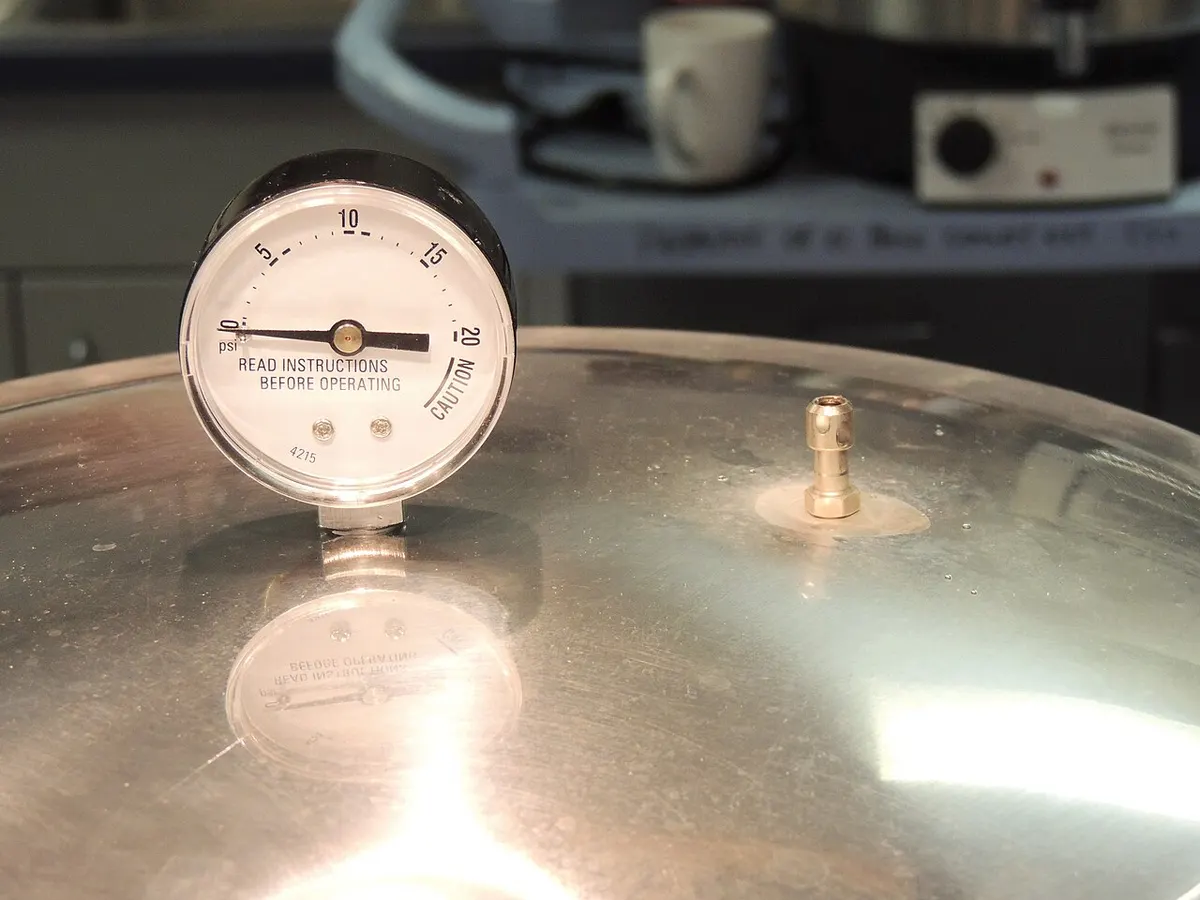
The best pressure canner for a beginner is a stovetop model that holds at least 4 quart jars, fits your stove, and uses a gauge you are willing to maintain. For most people that means one of two brands, Presto or All American, and one real decision: dial gauge or weighted gauge.
How we picked: we have not run these canners in our own kitchen. The recommendations below are based on manufacturer specifications, USDA and National Center for Home Food Preservation (NCHFP) requirements, extension guidance, and patterns in published owner reviews.
Why you need a pressure canner, not just a big pot
If you want shelf-stable green beans, corn, stock, beans, or meat, a pressure canner is the only safe home method. The NCHFP explains that low-acid foods (pH above 4.6) need temperatures of 240 to 250°F, which a canner reaches at 10 to 15 pounds of pressure. Boiling water tops out around 212°F, and botulinum spores survive it. The full explanation is in water bath vs pressure canning.
Two requirements come straight from the published guidance:
- Size: the USDA recommends a canner large enough to hold at least 4 quart jars to be considered a pressure canner for its published processes.
- It must be a canner, not a cooker. NCHFP does not support using USDA canning processes in electric multicookers, even models with a canning button.
Dial gauge vs weighted gauge: what is the difference?
This is the choice that shapes daily use.
| Dial gauge | Weighted gauge (regulator) | |
|---|---|---|
| How you read pressure | A needle on a dial | The weight jiggles or rocks at its set pressure |
| Pressure settings | Any, read off the dial | Fixed steps, usually 5, 10, and 15 lb |
| Maintenance | Test for accuracy every year | No dial to calibrate |
| Altitude handling | Fine steps (11, 12, 13 lb and so on) | Jumps from 10 lb to 15 lb above 1,000 ft |
| Attention required | Watch the dial and adjust heat | Listen for the rhythm |
Dial gauges let you run at exactly the pressure a recipe calls for, which is useful above 1,000 feet. The catch is accuracy. NCHFP says dial gauges should be checked each year before use, and replaced if they read high or low by more than 2 pounds at 5, 10, or 15 pounds. Many county extension offices test gauges; call your local office to ask.
Weighted gauges are simpler. NCHFP describes them as designed to jiggle several times a minute or rock gently when holding the correct pressure. There is no dial to drift out of calibration. The tradeoff is less precision: for vegetables, University of New Hampshire Extension’s tables have weighted-gauge canners at 10 pounds up to 1,000 feet and 15 pounds above that, while a dial canner can use 11 or 12 pounds in the same range.
Gasket vs metal-to-metal seal
The other big design difference is how the lid seals.
- Presto canners use a rubber sealing ring. It is inexpensive but wears over time and gets replaced as a regular part.
- All American canners use a machined metal-to-metal seal with no gasket at all. The maker’s line is “no gaskets to replace, ever.” The tradeoff is weight, price, and a lid you clamp down with wing nuts rather than twist on.
The best pressure canners for beginners
Best overall for most beginners: Presto 23-Quart Pressure Canner (01781)
Presto’s 23-quart canner is the most common starting point for a reason. According to Presto, it holds 7 quart jars, 20 pints, or 26 half-pints, has a dial gauge that registers the full range of processing pressures, and doubles as a boiling water canner for jams, pickles, and salsa. It carries an extended 12-year limited warranty.
It is built of aluminum and rated for regular and smooth-top ranges, but not induction. Presto also specifies household burners of 12,000 BTUs or less, which rules out many high-output outdoor burners.
Tradeoffs: a dial gauge you need to test yearly, and a sealing ring to replace as it ages.
Why we like it for beginners: seven quarts per load clears the USDA 4-quart minimum comfortably, it covers water bath jobs too, and replacement parts are easy to find.
Pantry pick: Presto 01781 23-Quart Pressure Canner

Seven quarts or 20 pints per load, a dial gauge, and a 12-year limited warranty, per Presto. Doubles as a water bath canner. Not for induction. Based on manufacturer specs and USDA capacity guidance.
Best for induction cooktops: Presto 23-Quart Induction Compatible Pressure Canner (01784)
Same jar capacity as the 01781 (7 quarts, 20 pints, 26 half-pints), but with a stainless steel-clad base. Presto lists it for gas, electric, smooth-top, and induction ranges, with the caveat that it may not work on all portable induction burners. Penn State Extension, discussing smooth cooktops, points to this kind of stainless-clad Presto canner as an option for induction.
Why it is here: most pressure canners are plain aluminum, which does not work on induction. If you have an induction range, this is the obvious starting point.
Pantry pick: Presto 01784 23-Quart Induction Compatible Pressure Canner

Same 7-quart, 20-pint capacity as the 01781 with a stainless steel-clad base Presto lists for induction ranges. Based on manufacturer specs.
Best buy-it-for-life canner: All American 921 (21.5 quart)
The All American 921 is the premium pick. It holds 7 quart jars or 18 pints, and uses the metal-to-metal seal described above, so there is no gasket to wear out. It has both a geared steam gauge and a three-way weighted regulator that sets 5, 10, or 15 pounds, and it is made in Wisconsin.
It is heavy, listed at 24 pounds empty, and the maker lists it for gas, electric, and glass-top stoves, but induction is not on that list. At 21.5 quarts, it fits a smooth top; All American notes its larger 930 and 941 sizes are too big for glass-top stoves.
Tradeoffs: a much higher price than Presto, and real weight when full.
Why it is our premium pick: no gasket, a weighted regulator for simple operation, and a design built to last decades. See current All American 921 listings.
Best smaller canner: Presto 16-Quart Pressure Canner (01755) or All American 915
If storage space is tight or you can in smaller batches:
- Presto 16-quart (01755): 7 quarts, 10 pints, or 13 half-pints, per Presto, with a dial gauge, a 12-year limited warranty, and the same 12,000 BTU burner limit. It still holds 7 quarts, just half as many pints as the 23-quart. Presto notes only half-pints and pints fit for boiling water canning.
- All American 915 (15.5 quart): 7 quarts or 10 pints, with the same gasket-free design as the 921.
Both clear the 4-quart-jar minimum.
Pantry pick: Presto 01755 16-Quart Pressure Canner

Seven quarts or 10 pints, a dial gauge, and a 12-year limited warranty, per Presto. The budget way into pressure canning if you rarely do pints. Based on manufacturer specs.
Pantry pick: All American 915 15.5-Quart Pressure Canner

Seven quarts or 10 pints with the gasket-free metal-to-metal seal and a 5, 10, or 15 lb weighted regulator. A premium canner in a smaller footprint. Based on manufacturer specs.
Pressure canner comparison
| Canner | Capacity (quarts / pints) | Gauge | Seal | Induction | Warranty (maker) |
|---|---|---|---|---|---|
| Presto 01781, 23 qt | 7 / 20 | Dial | Rubber sealing ring | No | 12-year limited |
| Presto 01784, 23 qt | 7 / 20 | Dial | Rubber sealing ring | Yes (not all portables) | 12-year limited |
| Presto 01755, 16 qt | 7 / 10 | Dial | Rubber sealing ring | No | 12-year limited |
| All American 921, 21.5 qt | 7 / 18 | Dial plus 5/10/15 lb weight | Metal-to-metal | Not listed | See maker |
| All American 915, 15.5 qt | 7 / 10 | Dial plus 5/10/15 lb weight | Metal-to-metal | Not listed | See maker |
Should you buy an electric pressure canner?
Keep two categories separate.
Electric multicookers (the Instant Pot style appliance) are not canners. NCHFP says its pressure process directions were not developed for them and it does not support canning in them, and Utah State University research cited by extension experts found various multicooker models did not reach temperatures high enough to kill all C. botulinum spores. The CDC also warns against using them for low-acid canning. Do not buy one for canning.
Dedicated electric pressure canners are different. The Presto Precise 12-Quart Digital Pressure Canner (02144) controls temperature with a sensor rather than pressure, and Presto says this means no altitude adjustments are needed. Presto states it tested the design with multiple thermocouples throughout the unit. The honest status, as of this writing: NCHFP has said it has no information on the type or extent of Presto’s research and cannot independently verify it, and extension staff advise owners to follow only the canner’s own manual. Neither USDA nor NCHFP certifies home canning equipment.
Our take: it is a real canner built for the job, not a multicooker. But it is the least independently documented option here, it costs more than a stovetop Presto, and you are limited to the recipes in its manual. For a first canner, a stovetop model with USDA-tested processes is the more straightforward choice.
How to choose: a quick decision guide
| Your situation | Our pick |
|---|---|
| First canner, gas or coil stove | Presto 23-quart (01781) |
| Induction range | Presto 23-quart induction (01784) |
| Want no gaskets and a weighted regulator | All American 921 |
| Small kitchen or small batches | Presto 16-quart or All American 915 |
| Above 1,000 feet and want precise pressure | Any dial-gauge model, tested yearly |
Before your first batch
- Read the canner’s manual cover to cover. Then follow a tested recipe.
- Vent for 10 minutes. NCHFP says all pressure canners must be vented with a steady funnel of steam for 10 minutes before pressurizing.
- Get the dial gauge tested before first use if it is secondhand, and every year after.
- Let it cool naturally. NCHFP warns that forced cooling can result in food spoilage.
The short version
- A pressure canner must hold at least 4 quart jars to use USDA-published processes.
- Pressure canners reach 240 to 250°F at 10 to 15 pounds of pressure; boiling water reaches about 212°F.
- Dial gauges need an accuracy check every year; replace one that is off by more than 2 pounds.
- Weighted-gauge canners run at 10 pounds up to 1,000 feet and 15 pounds above.
- The Presto 23-quart holds 7 quarts or 20 pints; the All American 921 holds 7 quarts or 18 pints.
- Only Presto’s 01784 in this list is sold as induction compatible.
- Electric multicookers are not safe substitutes for a pressure canner.
Related guides
Before you buy, make sure you know which foods need pressure: water bath vs pressure canning. If you are just getting started, our beginner’s roadmap to preserving food at home lays out the other methods too. Primary sources: the NCHFP on using pressure canners and the NCHFP statement on canning in electric multicookers.